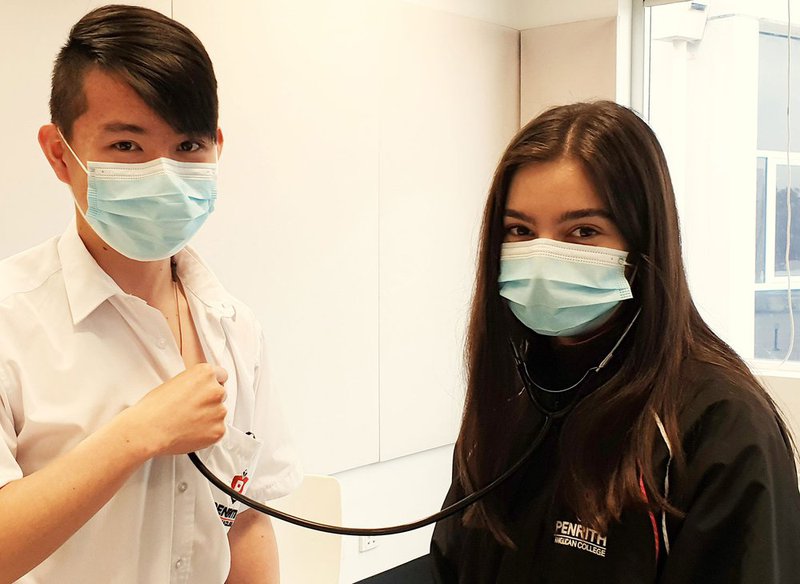
Job Spotlight - Medical Doctor
Preparing for a career in Medicine
Medicine is an exciting and rewarding career. The training required to accomplish this goal will be extremely
rigorous and take at least a decade, often longer, following completion of high school. Entry into medicine is
highly competitive. You will need to demonstrate perseverance to complete the training, a strong desire to help
others, a true intellectual curiosity about medicine in particular, and a love of learning in general. The following
tips may assist to guide your decision.
• Complete Year 12 (high school or college) or your undergraduate degree.
• Complete any pre-requisite subjects. Before selecting your subjects for your senior school years, do
your research to identify prerequisites and the courses to which they apply. Completing science prerequisites
during high school or your undergraduate degree is important, as it's much harder to complete
these pre-requisites after graduation.Remember, choosing high-level mathematics, chemistry, physics,
biology and English will stand you in good stead as you study medicine.
• Get involved. Take on leadership roles at your school and in your community to demonstrate you
can motivate your peers to action, particularly in ways that benefit the school or community. Consider
volunteering at a hospital, free clinic, doctor’s office or with a medical researcher. Volunteer work that is not
directly medical related such as with a charity or other community service is also valuable.
Medical schools do not judge applications on work experience, but gaining some work experience
demonstrates you have considered whether the demands of a caring profession is for you and that you are
committed to studying medicine.
• Take the UCAT or GAMSAT. Students interested in studying undergraduate medicine, dentistry and
some other clinical science courses at a member university of the University Clinical Aptitude Test (UCAT)
Consortium are likely to be required to sit the UCAT as part of their admissions process. Likewise, students
wishing to study a postgraduate medicine degree are likely required to sit the Graduate Medical School
Admissions Test (GAMSAT). Free guides for both the UCAT and GAMSAT are available. The GAMSAT test
is offered twice a year, in March and September.
• Choose a university that fits your needs. To find the right medical school for you, consider academic
reputation, size, distance from home, location, cost and of course their medical program. Apply to the
medical schools that best suit your ambitions.
Scholarships. There is a range of scholarships available to study medicine at an Australian university. For
Aboriginal and Torres Strait Islander students, the AMA Indigenous Medical Scholarship provides financial
assistance for completing a medical degree, or search the Aurora Indigenous Scholarship Portal for further
opportunities.
To learn more about preparing for a medical career, please visit Study Medicine. This site may assist you to
identify and compare Australian university medical degrees - direct entry and degrees leading to undergraduate
or postgraduate medicine.
Study Medicine – Medicine Offer Quiz
What are your chances of being accepted into direct entry medicine in Australia? Is your course preference
plan setting you up for success? Take the quiz to find out!
Free UCAT Webinars Summer Holiday Study Plan: How to Catch Up on UCAT Prep
21 November 2021 at 1pm - https://www.bigmarker.com/icanmed/summer-plan-1?utm_bmcr_source=website
5 December 2021 at 1pm - https://www.bigmarker.com/icanmed/summer-plan-2?utm_bmcr_source=website